
Is Your Preschooler Ready for Kumon? Understanding Developmental
Readiness Indicators
 8 min read • Oct 2026

Every parent of a young child has asked it — sometimes out loud, often quietly — Am I doing enough? When you see other three- and four-year-olds counting beyond ten, recognising letters, or sitting calmly with a worksheet, it's natural to wonder whether your child is on track, ahead, or missing something important.
At Kumon, we've worked with children from as young as age three for more than six decades. What we've learned — and what research consistently confirms — is that readiness isn't a single gate your child either passes or fails. It's a constellation of small, observable signals that together tell a story about where your child is, and where they're ready to go next.
This article walks you through those signals: the developmental readiness indicators that can help you understand whether your preschooler is ready to begin the Kumon journey.
"We at Kumon believe in the vast, untapped potential of every child.
The question isn't whether your child can learn — it's how to meet them where they are, and take the next step together."
What Does "Readiness" Actually Mean for a 3–6 Year Old?
The term "school readiness" is widely used — but rarely well-defined. In Singapore's education context, readiness for structured learning doesn't mean a child must already know how to read or count. Research from the Ministry of Education (MOE) and early childhood development experts defines readiness across these domains: cognitive, language, fine motor, social-emotional, and self-regulation.
What this means practically: a child who can sit still for three minutes, follow a two-step instruction, and hold a pencil is more "ready" than one who can recite the alphabet but melts down the moment a task becomes unfamiliar.
Kumon's approach is built entirely on this understanding. The programme starts each child at an individually assessed, comfortable starting point so that learning feels achievable, not overwhelming. The goal at the start isn't to challenge. It's to build confidence through small, consistent wins.
Age 3
Kumon’s earliest starting age
3.5M+
Students learning worldwide
60+
Years of proven method
70+
Centres across Singapore
5 Developmental Readiness Indicators to Observe in Your Child
Before rushing to conclusions, spend a few days observing your child at home and at play. These five indicators are the ones Kumon Instructors look for during a child's initial assessment.
1
Pencil grip and fine motor control
Can your child hold a crayon, pencil, or pen with some control — even loosely? Writing and drawing readiness begins here. Children who regularly colour, trace, or play with playdough develop the hand strength and coordination needed for Kumon's early worksheets. A relaxed, practised grip — not a perfect one — is the signal.
2
Ability to focus for short periods
Can your child stay with a single activity — a puzzle, a colouring book, a simple task — for five to ten minutes without being redirected? This isn't about silence or stillness; it's about sustained engagement. Research from the Harvard Center on the Developing Child shows that executive function skills, including focus and task persistence, are among the strongest predictors of academic success.
3
Basic number and letter awareness
Does your child recognise numbers 1–10 by sight? Can they name a few letters, especially those in their own name? This awareness — not mastery — signals that their brain is forming the foundational connections that maths and reading build upon. Kumon's Level 7A and 6A programmes in Maths start at number recognition and tracing, designed precisely for this stage.
4
Curiosity and a desire to "do it myself"
Does your child ask "why?" often? Do they resist help when they want to try something independently? This drive toward autonomy is one of the clearest signs of readiness for self-learning. The Kumon Method is built on independent study — the Instructor observes and guides, but the child does the thinking. A child who wants to figure things out on their own is perfectly matched for this approach.
5
Following simple instructions
Can your child follow a two- or three-step instruction at home? ("Put your shoes on, then get your bag.") This capacity for sequential understanding mirrors the logical, step-by-step structure of Kumon worksheets. It's also closely tied to reading comprehension — the ability to process a sequence of ideas in order.
Developmental Milestones by Age: A Parent-Friendly Reference
The table below summarises typical developmental milestones aligned to the readiness indicators above, alongside how Kumon's programme levels correspond. These are reference ranges — not fixed standards. Every child develops at their own pace.
| Age | Typical developmental milestone | Kumon programme entry point |
|---|---|---|
| Age 3 | Recognises familiar shapes and colours; holds crayon with full-hand grip; beginning to follow simple one-step instructions | Kumon Maths 8A / Reading 8A — colouring, tracing lines, building pencil control |
| Age 4 | Counts to 10; names several letters; draws a recognisable person; can sustain a single task for 5–8 minutes | Maths 7A–6A (number recognition); Reading 7A–6A (letter tracing, phonemic awareness) |
| Age 5–6 | Writes own name; counts to 20+; beginning to sound out simple CVC words; follows two-step instructions independently | Maths 5A–3A (number sequences, addition); Reading 5A–3A (word recognition, simple sentences) |
| Age 6–7 | Simple addition and subtraction; reads short sentences; sustained focus of 10–15 minutes; beginning to self-check their own work | Maths 2A–A (addition/subtraction fluency); Reading 2A–A (short passages, comprehension) |
Note: Kumon's free assessment will identify your child's exact starting point regardless of age. These are typical ranges only.
Is There Such a Thing as "Too Young" to Start Enrichment?
This is one of the most common questions parents ask and it's worth answering directly: Kumon accepts children from age three. The programme isn't designed to accelerate toddlers or push them into formal academics before they're ready. At this stage, the goal is entirely different.
For a three-year-old, the Kumon worksheet is not a test. It's a colouring page. A tracing exercise. A jigsaw-style sorting task. These activities develop the fine motor foundations that eventually become writing — but in the meantime, they build the habit of sitting, focusing, and completing a task independently. That habit, established early, is one of the most valuable gifts you can give your child.
Toru Kumon created the first Kumon worksheet in 1954 for his own son, Takeshi, who was struggling with maths in Grade 2. The worksheets he wrote were simple, carefully sequenced, and designed to be completed without help. Takeshi went on to study differential calculus by Grade 6. What began as a father's love became a global method for 3.5+ million children across 60 countries — and it still starts with the simplest possible step.
— The Kumon Story
The case for starting gently, not waiting
Research from the Early Childhood Research Quarterly Vol 70 highlights that foundational cognitive habits — pattern recognition, sequential thinking, and phonemic awareness — develop most efficiently during the early childhood years (ages 3–7). This isn't a reason to pressure your child. It's a reason to begin gently, when learning feels like play and the stakes are zero.
What about children who aren't ready yet?
Not every three-year-old will be ready for even the earliest Kumon level. And that's entirely normal.
If your child becomes easily overwhelmed, has difficulty sitting for even a few minutes, or hasn't yet developed basic pencil grip, a Kumon Instructor will tell you honestly — and may suggest returning in a few months. Kumon's assessment process is designed precisely to protect children from starting before they're ready.
The K1/K2 to Primary 1 Transition: Why Building Foundations Now Matters
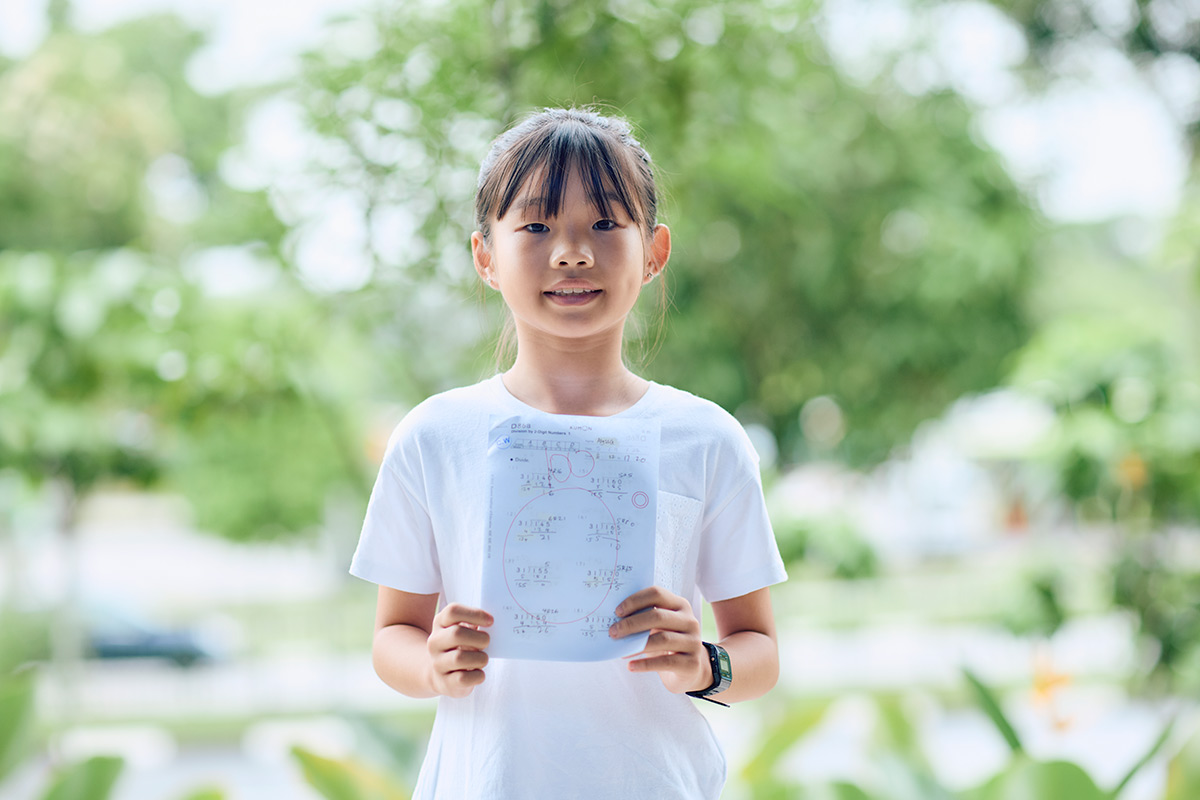
Singapore parents know the Primary 1 transition well. While MOE's Kindergarten curriculum (Nurturing Early Learners, or NEL) focuses on holistic development and purposeful play, Primary 1 introduces structured academic expectations across English, Mother Tongue, and Mathematics that can feel like a significant shift.
Children who arrive at Primary 1 with strong independent working habits, a confident number sense, and solid reading foundations consistently make this transition with less anxiety — for themselves and their parents. These aren't children who've been "drilled." They're children who've quietly built skills through consistent, self-paced practice.
What Kumon builds that school readiness tests don't measure
School readiness assessments typically measure cognitive and language milestones. What they don't capture is the learning disposition — the child's relationship with effort, independence, and persistence. Kumon's early programme, done consistently over months, shapes all three. A child who has learned to sit with a worksheet, attempt it independently, and feel proud of completion arrives at Primary 1 with something no test can measure: Confidence in their own ability to figure things out.
A Simple Parent Self-Assessment: Is Your Child Showing Readiness Signals?
Use this checklist as a starting point. It's not a diagnostic — it's a conversation starter, for you with yourself, and eventually with a Kumon Instructor. If you tick four or more, it's worth booking a free assessment.
Frequently Asked Questions by Singapore Parents
Next Steps: What Happens at a Kumon Assessment?
If you're considering Kumon for your preschooler, the first step is a free assessment at your nearest Kumon Centre.
Here's what to expect:
Your child will complete a short, age-appropriate set of tasks — not a test with right or wrong answers, but a way for the Kumon Instructor to observe their current level of pencil control, number awareness, and letter familiarity.
The whole process takes about 30 to 45 minutes and is designed to feel calm and low-key for your child.
You'll then have a conversation with the Instructor about what they observed, the recommended starting level, and what a typical Kumon week looks like for a child your child's age. There's no obligation. The goal is for you to leave with a clearer picture of where your child is — and where they could go.
With over 70+ Kumon Centres across Singapore, there's likely one near you. Your child's journey toward confident, independent learning starts with a single step — and it can start as early as age three. 🌱
Find out where your child is ready to begin
A free, no-obligation assessment takes 30–45 minutes.
Your Kumon Instructor will identify the perfect starting point for your child — by ability, not age.
Sources & Further Reading
- Ministry of Education (MOE) - Nurturing Early Learners (NEL) framework
- Harvard Center on the Developing Child - A Guide to Executive Function
- Early Childhood Research Quarterly Volume 70, Science Direct (T. Pham, M. F. Joanisse, D. Ansari et. al.) - Early cognitive predictors of language, literacy, and mathematics outcomes in the primary grades
- Ministry of Education (MOE) - Nurturing Early Learners (NEL) Framework

About the Author
World's Leading Enrichment Programme for Maths, English & Chinese · Est. 1958
The Kumon Singapore team is made up of dedicated supporting teams, Kumon Instructors, and enrichment specialists with a shared belief: every child holds vast, unrealised potential. Our content is grounded in more than 65 years of the Kumon Method — a proven, self-learning approach developed by Toru Kumon for his own son, and trusted by families in over 60 countries today. We write to equip parents with the insight they need to nurture independent, confident learners — one small step at a time. 
Continue Reading: Related Articles on Kumon Singapore
More from Kumon Singapore
In This Article
Programme
Kumon Enrichment
Since 1958
For children from age 3. Individualised, self-paced, and built on 60+ years of proven method.
About Kumon Singapore
Kumon has been supporting children in Singapore for decades, with 70+ Centres islandwide. Trusted by parents across 60 countries and 3.5 million+ students worldwide.